
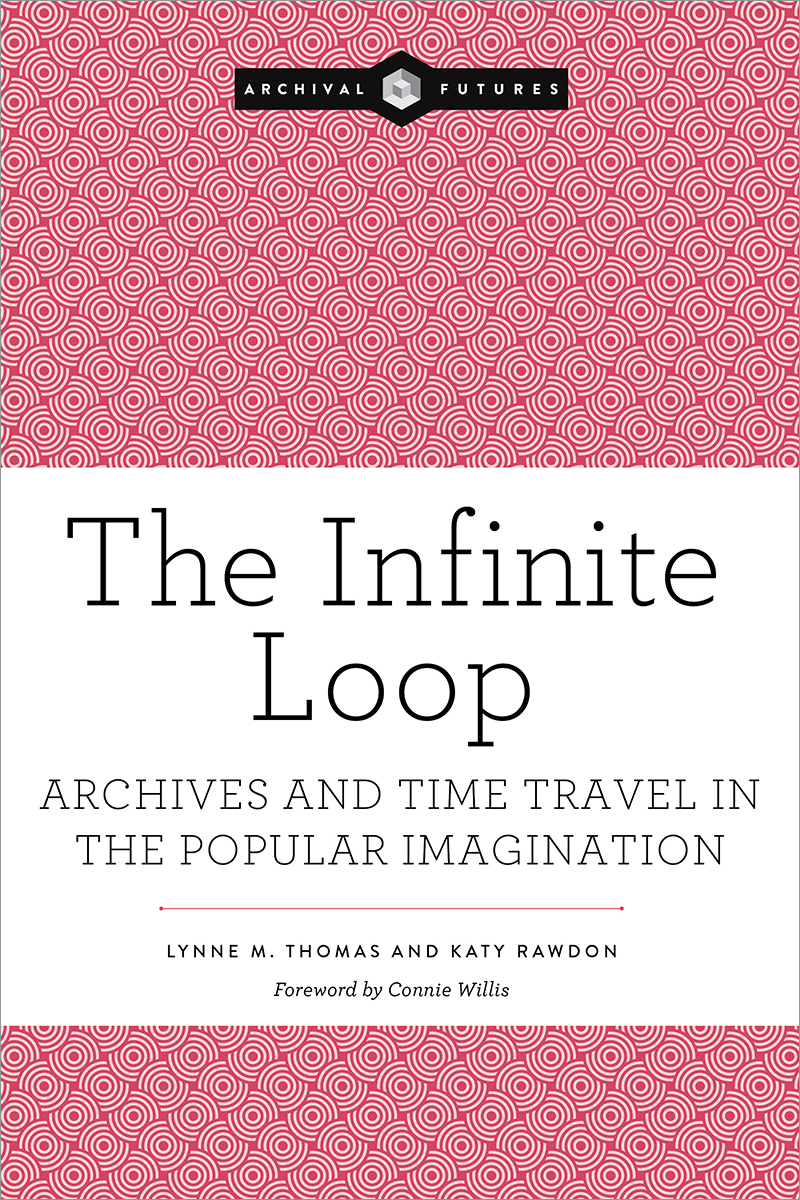
309: The Infinite Loop: Archives and Time Travel in the Popular Imagination, with Lynne M. Thomas and Katy Rawdon

Steve chats with Lynne M. Thomas and Katy Rawdon, authors of The Infinite Loop: Archives and Time Travel in the Popular Imagination, about how they each got into the profession, why archives can never truly be neutral and objective, how archives and special collections are portrayed within time travel narratives in pop culture, and what we can learn from those narratives to correct misconceptions and misinformation.

Read the transcript!

Spanning H. G. Wells’s The Time Machine to Marvel’s Loki, this delightful book considers how science fiction stories portray archives and archivists, analyzes the ways in which these portrayals affect readers’ views, and shows how archivists can leverage these insights to improve the public’s understanding of the discipline.

The fascination with time travel and its consistent popularity within the science fiction genre is deeply rooted in science fiction writers’ and readers’ passion for history and, by extension, for libraries and other kinds of archives. However, time travel, archives, and history intersect in the public imagination in ways that don’t always match up with the reality of archival work. This book engages archivists and devotees of science fiction alike by exploring common tropes within the genre—and common assumptions in the archival profession—and providing context. Presenting a book that can serve as a teaching text, readers’ advisory guide, and thought-provoking page turner, the authors

  • explore dozens of novels, short stories, movies, and TV series (particularly Doctor Who), spotlighting different science fictional approaches to writing about time travel while pointing out how archives and archivists are represented in different time travel stories;
  • examine how various cultures and societies view and understand time differently, using works such as Octavia Butler’s Kindred, Toshikazo Kawaguchi’s Before the Coffee Gets Cold, and Rivers Solomon’s An Unkindness of Ghosts to show how differences in temporal perception affect the presentation of time travel in their works;
  • look at stereotypes, outdated views, and biases depicted within time travel depictions of archives, comparing these portrayals with real-world archives and historical records;
  • discuss ways in which understanding time travel fiction can help archivists improve their relationships with the public and encourage more accurate fictional depictions of their work; and
  • connect the concepts in their book to cultural heritage practices that encourage critical thinking about archivists’ roles in documenting our times.

Twelve-time Hugo Award winner Lynne M. Thomas is the Head of the Rare Book and Manuscript Library and Juanita J. and Robert E. Simpson Rare Book and Manuscript Professor at the University of Illinois at Urbana-Champaign. She previously served as the Head of Distinctive Collections and Curator of Rare Books and Special Collections at Northern Illinois University in DeKalb, IL (2004-2017) where she was responsible for popular culture special collections including the literary papers of over 75 SF/F authors and the official archives of SFWA. She is the co-author of Special Collections 2.0 (Libraries Unlimited, 2009) and the co-editor of New Directions for Special Collections: An Anthology of Practice, both with Beth Whittaker (ABC-CLIO, 2016). An alumna of Smith College with a degree in French and Comparative Literature, she also holds an MS in Library and Information Science from the University of Illinois at Urbana-Champaign, and an MA in English and American Literature from Northern Illinois University. She co-edited the Hugo Award-winning Chicks Dig Time Lords (2010) with Tara O’Shea, and currently contributes to the Verity! Doctor Who Podcast.

Katy Rawdon is the Coordinator of Technical Services for the Special Collections Research Center at Temple University, a public research university in Philadelphia. She worked previously as the Director of Archives, Libraries, and Special Collections at the Barnes Foundation (2001-2012), an art collection and educational institution which houses one of the world’s greatest collections of impressionist, post-impressionist, and modern art. She co-authored the chapter “What’s in a Name? Archives for Black Lives in Philadelphia and the Impact of Names and Name Authorities in Archival Description” in Ethical Questions in Name Authority Control, (Library Juice Press, 2019), the Archives for Black Lives in Philadelphia Anti-Racist Description Resources (2019), and contributed to the Best Practices for Queer Metadata (2024) as part of the Queer Metadata Collective. A published author of romance novels (as Katy James) and poetry, and an enthusiastic fanfic writer, she has long been interested in intersections between popular culture and her work in special collections. She received her BA in Art History and Women’s Studies from Smith College and her MLS from Simmons College.

SHOW NOTES:

The Infinite Loop: Archives and Time Travel in the Popular Imagination
“The Big Idea: Lynne M. Thomas & Katy Rawdon” [Whatever, 19 March 2026]

284: Stories on Skin: A Librarian’s Guide to Tattoos as Personal Archives

Steve chats with Terry Baxter and Libby Coyner-Tsosie, authors of Stories on Skin: A Librarian’s Guide to Tattoos as Personal Archives, about the cultural and historical significance of tattoos, how body art intersects with themes like gender, queerness, and community memory, and broader topics related to archival practices, community engagement, and the evolving nature of libraries and archives in preserving diverse lived experiences.

Read the transcript!

Tattoos are not merely decorative; they contain deep meaning for individuals and communities. They document their wearers’ personal histories and position in families or society, and they engage with a communal understanding of symbols.

This unique book makes the case that archivists who want to preserve as full a human story as possible must recognize the rich documentation provided by tattoos. It also argues, in a broader sense, that traditional archives are not representative of the ways human beings transmit information through time and that they must be augmented by other types of storytelling to provide a more complete record of our species.

Authors Baxter and Coyner touch on timely topics such as historical narratives, storytelling, cultural traditions, the body as a text, social control, and memorialization by considering tattoos as a personal and community archive. Discussing tattoos as a storytelling tool, the authors also challenge how history is kept and who gets included. Stories on Skin is committed to the rights of communities to tell their stories in their own way and to the power that right brings.

Terry Baxter (he/him) has been an archivist for almost 40 years, the last 25 with the Multnomah County (OR) Archives, USA. He helped establish the County Archives in 2001 and continues seeking ways to use it to assist information seekers of all sorts. Baxter is a member of and has served in a variety of leadership positions in Northwest Archivists; Society of American Archivists; Association of Tribal Archives, Libraries and Museums; Archives Leadership Institute; and The Academy of Certified Archivists.

Libby Coyner-Tsosie (she/they) is the University Archivist at UMass Amherst in the W.E.B. Du Bois Library, USA, where she primarily cares for collections related to the history of the university. She was trained in archival studies and library science at the University of British Columbia and is a member of the 2016 cohort of the Archives Leadership Institute. She is a cancer survivor whose life has been reshaped by disability. Libby lives with her partner Shepherd and their five cats.

SHOW NOTES:

Stories on Skin: A Librarian’s Guide to Tattoos as Personal Archives

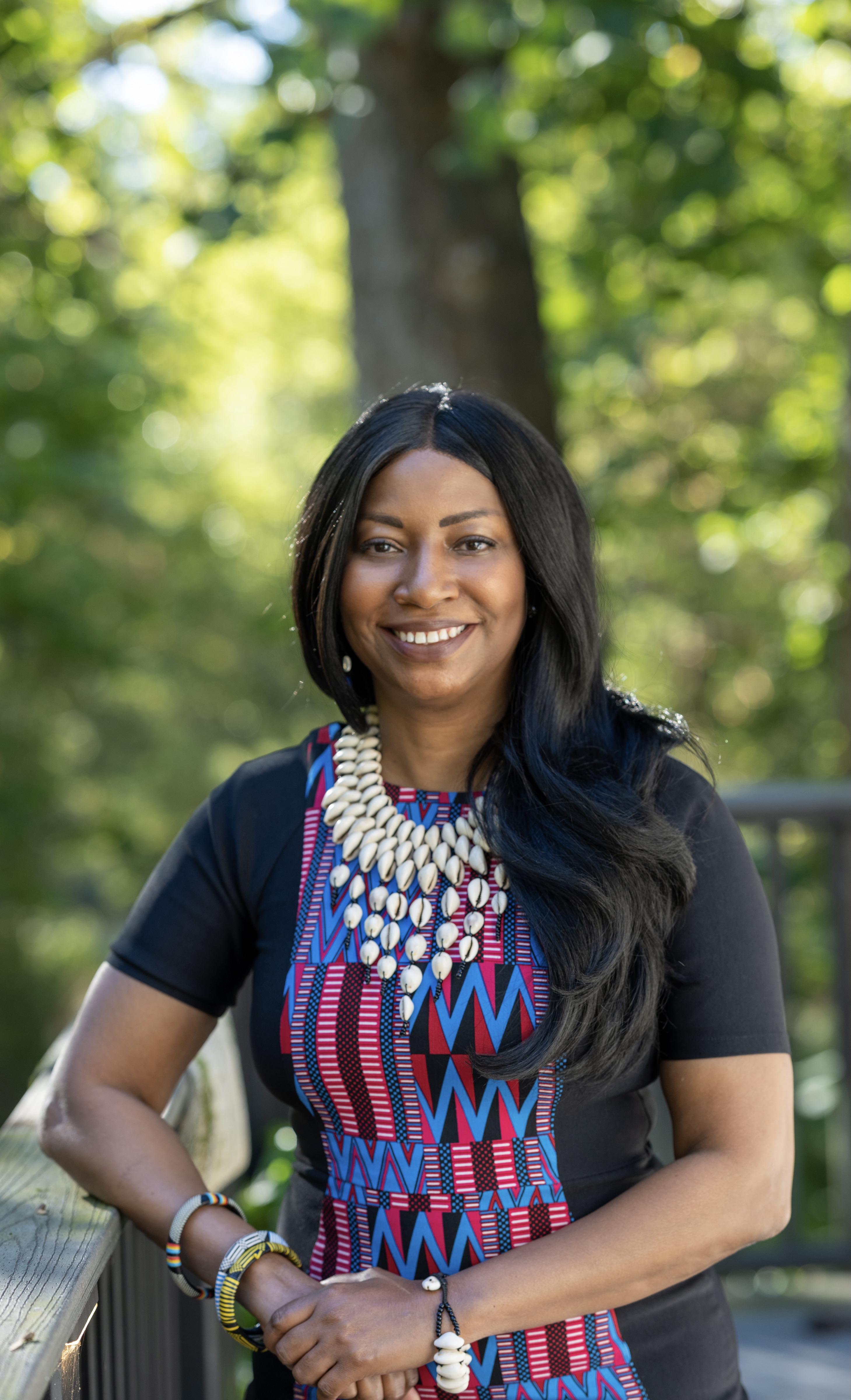
250: Tamar Evangelestia-Dougherty

Steve chats with Tamar Evangelestia-Dougherty, Director of the Smithsonian Libraries and Archives, about her path to librarianship, her experience of joining the Smithsonian, how they support equity, diversity, and inclusion, some favorite hidden gems held by the Smithsonian Libraries and Archives, and her plans for the future.

Read the transcript!

Tamar Evangelestia-Dougherty is the director of the Smithsonian Libraries and Archives. The recently integrated Smithsonian Libraries and Archives contains nearly 3 million library volumes and over 44,000 cubic feet of archival materials chronicling the history of the Smithsonian. Evangelestia-Dougherty oversees 137 employees, a national advisory board of 15 members, an annual budget of over $16 million and 22 library branches and reading rooms located in Washington, D.C., New York City, Maryland, Virginia and the Republic of Panama.

Previously, Evangelestia-Dougherty was an associate university librarian at Cornell University where she initiated Cornell RAD, a new research hub for rare and distinctive collections. She is also a faculty member of the UCLA California Rare Book School. As director of collections and services at New York Public Library’s Schomburg Center for Research in Black Culture from 2013 to 2014, Evangelestia-Dougherty led collection and programmatic development of five curatorial divisions. At the University of Chicago’s Black Metropolis Research Consortium, she served as executive director from 2011 to 2013 and as consulting archivist from 2007 to 2011. There, she successfully led initiatives to discover and make accessible archives related to the African American diaspora.

In addition to her extensive work with rare and distinctive collections, Evangelestia-Dougherty is a published author and public speaker who has presented nationally on topics of inclusivity and equity in bibliography, administration and primary-source literacy. She currently serves on the boards of Digital Scriptorium and the American Printing History Association.

Evangelestia-Dougherty holds a Master of Science in information science from Simmons University’s School of Library and Information Science in Boston and a bachelor’s degree in political science from the University of Houston.

SHOW NOTES:

Smithsonian Libraries and Archives
Sign for the Circulating Ideas newsletter for more!

224: Area Studies Librarianship with Liladhar Pendse

Guest host Natalia Estrada chats with Liladhar Pendse, librarian for Slavic, East European, and Eurasian Studies and the Caribbean and Latin American Studies at the University of California-Berkeley, about the concept of Area Studies, his work archiving Afghanistan’s digital and cultural content after the US withdrawal, the challenges of archiving war-torn areas such as Ukraine, and his advice for new librarians looking to enter his field.

Read the transcript!

Liladhar R. Pendse is a librarian for Slavic, East European, and Eurasian Studies and the Caribbean and Latin American Studies at the University of California-Berkeley. He has been with the University of California Library system since 2002 and possesses a wide range of expertise in Area and International Studies within academic libraries. Liladhar tries to educate himself through collaboration with his colleagues and continuing education opportunities. Liladhar considers librarianship to be his vocation and lacks an on-and-off switch when it comes to meeting user needs.

Natalia Estrada (she/they) is the Digital Scholarship Librarian at SUNY Buffalo. She’s worked in various academic library staff positions for more than 15 years and has focused her research on organizational hierarchy in the academic library. She’s also the host of the podcast Digital Explorer, the podcast about digital scholarship and our relationship with computers and the internet. Born and raised in the LA area, Natalia is interested in Legos, arts and crafts, weightlifting, the intersection of neurodiversity and Latinx identity, and chaotic energy.

SPONSOR:

Syndetics Unbound, from ProQuest and LibraryThing.
Today’s show is brought to you by Syndetics Unbound, from ProQuest and LibraryThing. Syndetics Unbound helps public and academic libraries enrich their catalogs and discovery systems with high-interest elements, including reader’s advisory, cover images, summaries, author profiles, similar books, reviews, and more. Syndetics Unbound encourages serendipitous discovery and higher collection usage, and was awarded Platinum distinction in the LibraryWorks 2021 Modern Library Awards. To learn more about Syndetics Unbound, visit Syndetics.com. While there, be sure to visit the Syndetics Unbound Blog for news and analysis, including a break-down of libraries’ top titles and other stories of interest to the library community.

SHOW NOTES:

Subscribe (FREE!) to the Circulating Ideas newsletter!

158: Molly Schwartz

Steve chats with Molly Schwartz, host and producer of Preserve This Podcast and archivist and audio producer at the Metropolitan New York Library Council (METRO), about how she started working with libraries and archives, the importance and challenges of preserving born-digital media, and the details of the Preserve This Podcast project.

Molly Schwartz is a trained archivist and audio producer at the Metropolitan New York Library Council (METRO). She is the host and producer of Preserve This Podcast. She is also a freelance tech journalist whose work has appeared in The New York Times, New York Magazine, and Public Radio International’s America Abroad.

This episode of Circulating Ideas is brought to you with support from Mometrix. Through their eLibrary portal, Mometrix offers study guides and practice questions for over 1800 different exams covering college entrance, graduate school, nursing, medical, teacher certification, civil service, and many other careers or fields of study, all fully customizable and at a fraction of the cost of printed books. It’s like having an entire library of test prep materials…. all at your fingertips. So, save space, save paper, and save money; with Mometrix eLibrary. To learn more, visit GOeLibrary.com and use promo code PODCAST to get a free demo and save 10% on your first purchase.