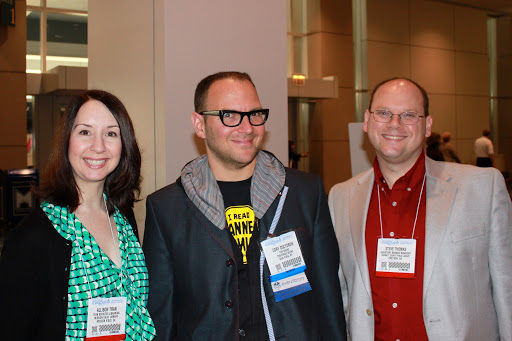

Kate Kosturski is JSTOR’s Institutional Participation Coordinator for the UK and Northern Europe, where, in her words, “I tell people in Europe how awesome JSTOR is and then hopefully they buy some.” A 2011 ALA Emerging Leader, Kate received her MLS from Pratt Institute in 2010 and is the co-founder of ALA CraftCon, a relaxing crafting hour at the Midwinter and Annual Meetings. In her spare time, she enjoys crafts, cooking, baseball, running, photography, politics, and technology. View her work online at katekosturski.info and follow her on Twitter as librarian_kate.
Coral Sheldon-Hess is an engineer-turned-librarian living in Anchorage, Alaska. She has worked at the University of Alaska Anchorage as a Web Services Librarian since 2009, when she drove across the continent with three birds, some house plants, and a trunk full of homebrewing gear. In her spare time she teaches computer programming to women, crochets, does geeky tech things, reads, bicycles (poorly), and evangelizes on behalf of the Oxford comma. You can find her blog at http://sheldon-hess.org/coral, or follow her on Twitter at @web_librarian.
Marge Loch-Wouters received her MLIS in 1976 at UW-Madison SLIS and had worked as a children’s librarian and children’s library manager ever since. She is a long time active member of ALA (she currently sits on Council), Wisconsin Library Association and WI Women Library Workers, a feminist library organization. She blogs at Tiny Tips for Library Fun and also presents workshops, webinars and teaches as an adjunct on innovative youth services. Loch-Wouters was named WI Librarian on the Year in 2010. When not working she can be found hanging out in social media or in nature.
Buffy Hamilton was not supposed to be the first guest on the show but I’m sure glad that she was.
Now, a few years back, I had first really gotten involved in the online librarian world through Leah White’s Young Librarian Series (and you can hear Leah on the show here, here, and also here). I had been getting more and more involved with professional activities on Twitter, including a stumbling attempt at keeping up a blog, and was looking for a way to contribute and participate more.
I had also been listening to a lot of podcasts, my favorite at the time being Fresh Air with Terry Gross, and realized that I wanted to hear an interview show featuring librarians. I searched around and while there were great library-related shows like T is for Training and Adventures in Library Instruction, they weren’t quite what I was looking for, so I decided to create it myself. Bobbi Newman was scheduled to speak at a local professional development event, and since I’d been following her work through her blog and Twitter, I got it in my head that I would interview her as my first guest. However, I couldn’t quite get everything together in time, so that fell apart (though Bobbi was a valuable asset for brainstorming and promotion of the show and I can’t thank her enough for that).
I had recently met Buffy Hamilton through social media and we clicked as colleagues and friends, and I was incredibly impressed with her efforts at her middle school library, so I asked her to be my first guest (I think she agreed because I was more interested in her Media21 program than her Kindle loaning program, which is all anyone else asked her about). The interview with Buffy completely set the tone for the show moving forward, despite some technical difficulties. My initial thought for the show was that I would ask questions and wait for the interviewee to answer, but it became more conversational, more back and forth, more engaging, helping it live up to its name.
I went on to interview many of the people I’ve looked up to in the profession that I never thought would agree to be on, like Sarah Houghton, Jessamyn West, David Lankes (not once, not twice, but three times!), the Unshelved guys, and the upcoming interview with Nancy Pearl. The show has been a tremendous source of inspiration for me, and I hope, for the listeners.
Thanks to all the guests who have appeared on the show over the past two years, to the guest hosts who helped me get through an exceptionally busy time, to all the colleagues and friends who have acted as sounding boards for crazy new ideas, to my wonderful listeners, many of whom came out to support the Kickstarter campaign, and of course my beautiful wife and kids for patiently putting up with me constantly making our printer unusable because my mic was using its USB port.

Kate Sheehan is the special projects coordinator for Bibliomation,a consortium of public and school libraries in Connecticut. She joined Bibliomation in 2009 to work on their migration to the Evergreen ILS as the open source implementation coordinator and has been fortunate that the good people of Bibliomation have been willing to scrape together funding to keep her popping up at meetings. Kate has been the coordinator of knowledge and learning services at Darien Library and the coordinator of library automation at Danbury Public Library, which was the first library to implement LibraryThing for Libraries. Prior to joining Danbury Public Library, she was a technology and reference librarian at the Ferguson Library in Stamford, Connecticut. A graduate of Smith College, Kate’s post college experiences in the corporate workplace inspired her decision to get an MSLIS from Simmons. She finished library school in December of 2003 and has been happily ensconced in the public library sphere since then. When she’s not coordinating, she works as a writer and consultant and blogs at loosecannonlibrarian.net, ebookprimer.com and ALA TechSource.
Meredith Farkas is the Head of Instructional Services at the Portland State University Library in Oregon and is an adjunct faculty member at San Jose State University’s School of Library and Information Science. She’s also the author of the book Social Software in Libraries: Building Collaboration, Communication and Community Online (Information Today, 2007) and writes the monthly column “Technology in Practice” for American Libraries. She’s the creator and manager of Library Success: A Best Practices Wiki and has created a number of well-known national conference wikis (ALA 2005 and 2006, Internet Librarian 2006-2008, etc.). She has presented internationally on topics such as social technologies, managing library technology projects, encouraging innovation organizationally, and LIS education. In 2006, she was named a Mover and Shaker by Library Journal for innovative uses of technology to benefit the profession and in 2009 she was honored with the LITA/Library Hi Tech award for Outstanding Communication in Library and Information Technology.
She lives with her wonderful husband and adorable toddler son in one of the best places in the world and feels lucky to have been able to achieve what she has in both her professional and family life.
Jenica P. Rogers is Director of Libraries at the State University of New York at Potsdam, coming from a background in cataloging, collection development, and staff training.
Jenica serves as the chief administrator of the Crumb and Crane Libraries, with responsibilities that include short-term and strategic planning, fiscal management, fundraising and donor development, representing the libraries to outside constituents, and supervision of 24 FTE employees spanning NYS Civil Service employees, professional staff, and librarians.
Jenica’s current professional interests include interrogating the ways our information economy is breaking down and reforming now that the internet changed everything, figuring out what the role of a library is in a reality in which warehousing books is sort of passé, and informing, mentoring, and supporting new library professionals as they hit the real world face first and at full speed.
Jenica earned her MLIS from the University of Wisconsin-Madison in 2001 after graduating from Trinity College in Hartford, CT in 1998 with a BA in English Literature. In 2009 she received a SUNY Potsdam President’s Award for Excellence in Professional Service and was was nominated one of Library Journal’s Movers and Shakers for 2009.
Karen Schneider is the University Librarian at Holy Names University in Oakland, California and she has just embarked on a PhD program at Simmons College. She blogs at Free Range Librarian and she has published over 100 articles and 2 books.Her less technical writing includes essays, portraits, travelogues, video reviews, and a historically dubious account of Washington crossing the Delaware. She has been published in The Best American Nonrequired Reading 2009, The Best Creative Nonfiction Volume 2, Gastronomica, White Crane, Nerve, Ninth Letter, Linux.com, IT Managers Journal, American Libraries, Library Journal, The Bottom Line, the dear departed Wilson Library Bulletin, a few other places she can’t remember, and has articles forthcoming elsewhere, but chooses not to jinx the process by naming the lucky publications.
Schneider’s technology writing has been recognized in a variety of venues for being both lively and learned (“venues” in this case meaning “homes of close friends or relatives”). From 2005 through 2007 she wrote at ALA Techsource, where readers showered her with compliments such as “Stop using the work ‘suck’, you tramp!” and “My cataloger can beat up your metadata specialist!” From 1995 to 2001, as the Internet Librarian columnist for American Libraries (circulation 66,000), Schneider consistently ranked in magazine surveys as AL’s most popular author. In 1998, her article “The Tao of Internet Costs,” one of the first discussions within librarianship about sustainable technology funding, was selected as an article of the year for The Bottom Line, a journal of library finances. In 1998, as author of A Practical Guide to Internet Filters, Schneider provided expert testimony for Mainstream Loudoun vs. Board of Trustees, a pivotal First Amendment case about free speech on the Internet.
An Air Force veteran (1983-1991), graduate of Barnard College, University of Illinois, and University of San Francisco, and skilled treadmiller, Schneider now divides her free time somewhat unevenly between housework and watching television when she is not working on her collage of rejection letters she receives for those depressing little belles-lettres she insists on begging editors of fine journals to read.
Schneider, a world traveler who has lived in such exotic locales as Clovis, New Mexico and Tallahassee, Florida, now lives in her lavishly overpriced home town, San Francisco, with her long-suffering partner Sandy and their spoiled cats, Samson and Emma.
This is part two of the conversation. Part one is here.
R. David Lankes is a professor and Dean’s Scholar for the New Librarianship at Syracuse University’s School of Information Studies and director of the Information Institute of Syracuse. Lankes has always been interested in combining theory and practice to create active research projects that make a difference. Past projects include the ERIC Clearinghouse on Information and Technology, the Gateway to Education Materials, AskERIC and the Virtual Reference Desk. Lankes’ more recent work involves how participatory concepts can reshape libraries and credibility. You can hear earlier Circulating Ideas interviews with Dr. Lankes here and here.
Jill Hurst-Wahl, MLS, is a digitization consultant and owner of Hurst Associates, Ltd. She also an Associate Professor of Practice in Syracuse University’s School of Information Studies and the director of the iSchool’s Library and Information Science Program. She is a member of the SLA Board of Directors (2011-2013). Jill’s interests include digitization, digital libraries, copyright, web 2.0 and social media.
Cori Dickerson is an absentee MLS student and a part-time librarian in the great state of Texas. Her art and English degrees keep her in the lap of luxury, and the high school students keep her from making any progress on her To Read list. Cori’s trying very hard not to be a responsible adult, and spends far too much time playing Star Wars: The Old Republic. (Star Trek is her one true love, however!) She can generally be spotted on Twitter and Pinterest, scavenging ideas from much cooler people.
This is part one of the conversation. Part two is here.
R. David Lankes is a professor and Dean’s Scholar for the New Librarianship at Syracuse University’s School of Information Studies and director of the Information Institute of Syracuse. Lankes has always been interested in combining theory and practice to create active research projects that make a difference. Past projects include the ERIC Clearinghouse on Information and Technology, the Gateway to Education Materials, AskERIC and the Virtual Reference Desk. Lankes’ more recent work involves how participatory concepts can reshape libraries and credibility. You can hear earlier Circulating Ideas interviews with Dr. Lankes here and here.
Jill Hurst-Wahl, MLS, is a digitization consultant and owner of Hurst Associates, Ltd. She also an Associate Professor of Practice in Syracuse University’s School of Information Studies and the director of the iSchool’s Library and Information Science Program. She is a member of the SLA Board of Directors (2011-2013). Jill’s interests include digitization, digital libraries, copyright, web 2.0 and social media.
Cori Dickerson is an absentee MLS student and a part-time librarian in the great state of Texas. Her art and English degrees keep her in the lap of luxury, and the high school students keep her from making any progress on her To Read list. Cori’s trying very hard not to be a responsible adult, and spends far too much time playing Star Wars: The Old Republic. (Star Trek is her one true love, however!) She can generally be spotted on Twitter and Pinterest, scavenging ideas from much cooler people.
Paula Brehm-Heeger has worked in public libraries for nearly two decades. Currently an administrator with the Public Library of Cincinnati and Hamilton County, Paula is professionally active on a local, state and, national level. She has served as President of the Young Adult Library Services Association (YALSA), a division of the American Library Association, as a member of the Ohio Library Council Board of Directors, and is currently serving as a member of ALA Council. Paula has contributed writings to the Public Library Association’s Public Libraries, VOYA, School Library Journal, and YALSA’S Young Adult Library Services Journal. She is the author of ServingUrban Teens (Libraries Unlimited, 2008), and the 2010 article she co-authored for Public Libraries, “Remaking One of the Nation’s Busiest Main Libraries”, was named a Feature Article of the Year.
When I was five years old, fireflies were my friends. In the small South Carolina town of Sumter, I would walk outside as the day wound down into dusk, put my hand in the air and delight as the fireflies would land on my fingers. I would cup my hand over them, peeking between my fingers to watch them walk around and light up their temporary home between my palms. I named them all Sunny.
One day, one of my Sunny friends landed on my hand but this one looked a little different than the others. His backside was yellow but there was no light on it and he was rounder and fuzzier than I remembered. He also didn’t seem to appreciate his new home much, which I discovered when he stung me.
The final Sunny was a bee.
I can still remember how utterly betrayed I felt, that one of my beloved friends had hurt me. He wouldn’t be the last, of course, but he was the first. For awhile, I didn’t try to catch fireflies anymore, but I did eventually drift back, though I never named another.
Now, that was not an awesome experience. As much as I can still feel the pain that last Sunny caused (both physical and emotional), I can also recall the joy all the other Sunnies brought me, but I didn’t have the life experience to understand that one bad experience should not spoil countless good ones.
The thing about being an adult is that now I do understand and in a professional sense, that is what I try to do with the podcast I created, Circulating Ideas: show off the good experiences we create in libraries, which far outnumber the things not going our way. The profession is filled with innovative people, and I want the show to be a platform for them to show off how awesome they are. When I promote the show, I’m also promoting those guests who have been on and will be on, paying it forward.
I have done a lot of promotion for the show in the past, from writing guest posts for other blogs to appearing on other podcasts to posting updates to multiple social media accounts (some that I update more the others), but the biggest piece of self-promotion I’ve done, which is somewhat unique in the world of libraries, is my Kickstarter campaign, which ends on May 17.
Kickstarter allows creative projects to gather pledges to fund themselves, providing rewards to backers, with the safety net being that if a project is not fully-funded, no one pays out. Before embarking on this self-promotional journey, I studied successful Kickstarter projects and other projects related to podcasts and libraries (there were not a lot!), to see what the expectations were on setting rewards and how projects were presented. I listened to the New Disruptors podcast, which talks to people who use nontraditional ways of raising capital for their projects, and read more articles on Kickstarter than I care to count. I put together what I thought was a reasonable package to help me expand and enhance the show and went live. Within 48 hours, the project had been fully funded and the pledges continue to trickle in. So far, I have passed my first stretch goal – which are additional goals set, after initial funding is achieved – and hope to pass at least the second goal before the project ends. As much as the Kickstarter project will help me make the show bigger and better, it has also brought a lot of attention and I’ve hopefully picked up more listeners along the way, which will bring them to the attention of all the great people featured on the show.
We sometimes feel stung from the attacks on libraries but we need to remember that the future is bright for libraries if we can embrace the best of our profession and push forward into more sunny days. My hope is that I’m able to be a part of that, and I hope you will be, too.
Want to know more about the 30 Days of Awesome project? Check out these posts by Kelly, Liz, and Sophie.
Two years ago when I started doing Circulating Ideas, I had only my five year old iMac, GarageBand, and Skype, with my site set up on Google’s free Blogger platform. The earliest monetary investment I made was securing the domain name registration. You can hear the poor audio quality in those first few episodes until I upgraded to a Blue Snowball mic and added Audacity to my mix of sound tools. I continue to work on the same iMac (with a hard drive upgrade) and still use GarageBand as my primary editing tool. When I attended the Public Library Association conference in the Spring of 2012, I was able to use some equipment loaned from my place of work, like a portable digital recorder and a laptop, because I had been sent by them to cover the conference; this was nice because otherwise I had no options for recording on the go (I didn’t even have a smartphone at that point).
Now I can continue along like this for the foreseeable future and keep interviewing more great, innovative librarians but in order for the show to grow and flourish, I need to upgrade not only my mobile options but also my home office equipment. I do the show on my own time, outside of work, so all current costs and any prospective upgrades come out of my own pocket.
However, that’s where you can come in to help.
I’ve started a Kickstarter campaign to support the show and I would appreciate any help you can provide. If you don’t have money to give, just passing along this information about the campaign would be a great help. I’ve started off with some modest goals for improvements and have plans for stretch goals beyond the initial funding request to provide bigger and better services with more advanced equipment and software with additional fun rewards to go along with it.
Thanks for helping to circulate the ideas.

Troy A. Swanson is Teaching & Learning Librarian and Library Department Chair at Moraine Valley Community College in the USA. Troy has managed the library’s web presence since the year 2000. He implemented his library’s blogs in 2004 using a content management approach, and the library’s first podcasts for cultural events in 2006. He has published on the library website design and usability in the Journal of Academic Librarianship and Internet Reference Services Quarterly. Troy also writes as a guest author on the Tame the Web blog. His Ph.D. dissertation focused on the management of Web 2.0 in higher education. He has also written on information literacy instruction for college students. Troy lives in the Chicago suburbs with his wife Kim and their three children.